


Board of Trustees
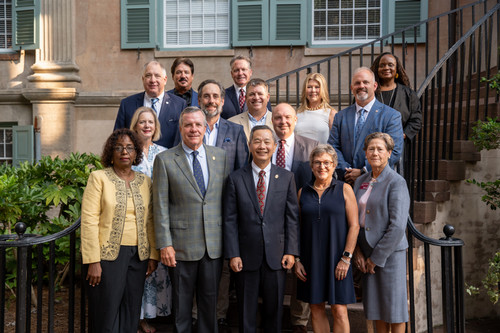
At the Board of Trustees Meeting Thursday, August 11, 2023.
Photo By Catie Cleveland
The Board of Trustees consists of 20 members; two members from each of the South Carolina congressional districts, three at-large members elected by the General Assembly, one member who shall be the Governor or designee, one member appointed from the State at-large by the Governor and one member appointed by the Governor upon the recommendation of the College of Charleston Alumni Association.
The final authority and responsibility for the governance of the College of Charleston is vested in the Board in accordance with the statutes of the State of South Carolina. Although the Board of Trustees delegates the administration of the campus under its authority to the President of the College, its right to intervene in all matters pertaining to the College is not abrogated by this delegation of authority.
For more information, read a brief history of the College of Charleston.
On May 7, 2020, the Board of Trustees approved the Strategic Plan.
The Trustees Named in the Charter of 1785
- Gov. William Moultrie
- Lt. Gov. Charles Drayton
- Joseph Atkinson
- Thomas Bee
- Richard Beresford
- Daniel Bourdeaux
- Daniel De Saussure
- Thomas Heyward, Jr.*
- Richard Hutson
- Ralph Izard
- John Lloyd
- Gabriel Manigault
- John Matthews
- Arthur Middleton*
- David Oliphant
- Charles Pinckney**
- Charles Cotesworth Pinckney**
- David Ramsay
- Edward Rutledge*
- John Rutledge**
- Robert Smith
- William Loughton Smith
- Arnoldus Vanderhorst
* Signed Declaration of Independence
** Signed U. S. Constitution